

Collaborators in Arms


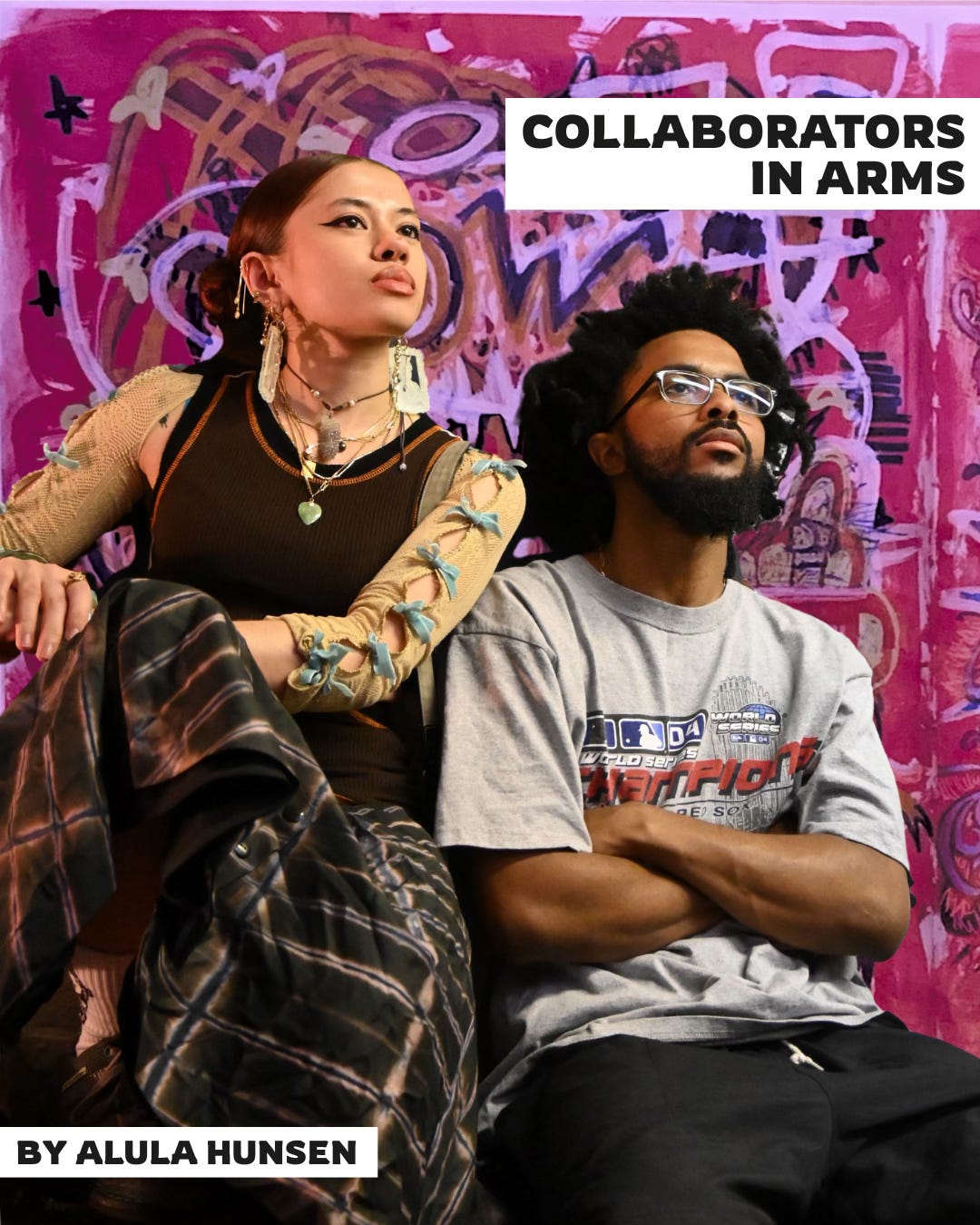
Tomo Singh and Sam Le Shave work, show and prove what artists in a dialogic relationship can build together.
My companions and I waited outside the studio building wondering if we’d lollied/gagged a little too aimlessly on a warm late spring Friday evening, on June 6th, too late to catch a duo show pulled together by local luminaries (and friends/acquaintances to the waiting party) Tomo and Sam LeShave.
I knew Tomo, knew of Sam, and hoped I’d be able to see Tomo’s work up on a white wall; I’d seen his tags and mural-like work up around town (including just down the street from my old apartment, on the sidewalk median in front of South Bay Plaza), representations of his singular and frenetic output across any and all media. Friends of our friends (and friends of ours, including writer Bria Smith, editors-in-chief of Guerrilla Magazine Vik and Tatiana, and rapper/cooperative owner/frequent collaborator HAAWWS) emerged from the studio building, greeting us warmly and letting us know that Tomo would be down soon to bring us up into the belly of SoWa’s artist gallery/studio South End behemoth. While we’d missed the show’s opening, a mix set and a warm crowd, we still were able to see the pieces themselves—mostly painted canvases from both artists (with some mixed media and textile work), which felt similar but not congruent between the two of them, informed by street art, and before that, by graf. Both Tomo and Sam are from Dorchester (Upham’s Corner and Fields Corner, respectively); seeing their work in a studio space emblematic of gentrification, in a neighborhood accused of displacing local artists, felt important.
I came back the following weekend, visiting Sam at the next SoWa Sundays Open Studio, to take in the work once more and to have a real conversation with Sam beyond seeing each other around. She’d been practicing what I considered a form of mutual aid, what she considered peer-to-peer support, relationality and learning between artists, allowing her studio to double as showing space for artists she was in community with and making work alongside these artists collaboratively; Tomo was the latest artist to work with her in this capacity, hence their dual showing. We spoke about how she uses text and language, obscuring from the viewer meanings only legible to her—she’d borrowed this tactic from graffiti writers, producing letterforms which were meant to function as signifiers to all, signifying only to her something internal. In front of one of Tomo’s pieces, “Blood Money,” we talked about the futility and frustration which comes with commodity fetishism and how Sam struggles with attaching a price tag to her work, sometimes with even making work to be intentionally sold— behind us, another piece from Tomo asked, “how much will you sacrifice?”
Tomo, who once joked on the Bad For The Community podcast that, if given $100,000, he would bet $30,000 on a parlay, might have answered, “everything.” Tomo, who’s been rapping and making art since he was 15, embodies a hip-hop maxim that historian and fact-checker Dart Adams loves to recall: “hip-hop is something you do.” As a mixed-media artist, rapper, producer, engineer, fashion designer, and graffiti writer, there’s little Tomo restricts himself from envisioning or making. He characterizes his artistic practice as often spontaneous and DIY, naturally inflected by his style and his approach to graf; his work is often representational and figurative, populated with characters, and sometimes referential to other cultural tentpoles—as post-modernist as his graffiti origins. Sitting next to Sam’s work, much more abstract/expressionist, vibrant, and drawn to curvilinear forms, the two fit, but it’s clear whose work is whose. Still, their collaboration was easy-going; sitting in on a work session where Tomo, Sam, and friend Anny Thach slipped into and out of conversation as Tomo and Sam worked on a paint-on-fabric piece together, it became clear that their spontaneities and attitudes of co-creation allowed them to flow:
Tomo: It’s been kind of fluid. No bullshit. I feel like we have similar creative styles… sometimes I’ll overthink shit, but I don’t like to overthink shit. So when we started, I was like, “what should we do?” And then she was like, “let’s just work on it right now.”
Sam: We kind of just let it happen…
Tomo: Just bounce ideas.
Sam: Yeah. I feel like naturally there’s a flow… we’ll work on something and kind of just gauge the other person.
Both Sam and Tomo find it important to find space and place in their neighborhoods to produce work on city surfaces—Tomo is now a paid muralist, and Sam, too, now has mural work up in Dorchester as part of “The Mural Project,” a two-day event where both artists invited friends and community to join them in painting boulevard medians with emblems and artefacts of culture. Representing their city well comes naturally, if not easily, to the pair. Sam was a mentee in Artists For Humanity’s teen program, and organized with the Asian American Resource Workshop for three years; Tomo is himself a mentor and educator with Teen Empowerment, connecting young people in the City of Boston with opportunities and showing them paths towards creative careers which do not require them to leave behind their families, friends, and communities. Neither plan on leaving Boston, or even leaving their home neighborhoods, for greener pastures elsewhere; instead, both hope to make home into the greener pasture it can be for artists who come after them.
 | A guest post by
|